 PTF Punjab
How the E-Bike Scheme Supports Punjab's Clean-Air Strategy
Punjab's Growing Pollution Challenge
Punjab province has been grappling with deteriorating air quality for over a decade. During the winter months of October through February, a thick layer of smog settles over cities like Lahore, Faisalabad, Gujranwala, and Multan, reducing visibility to dangerous levels and causing widespread respiratory illness. The Punjab Environmental Protection Agency (EPA) reports that Air Quality Index (AQI) readings regularly exceed 300 — a level classified as "hazardous" by international standards. Schools have been forced to close for weeks at a time, and hospitals see a 40% surge in respiratory cases during peak smog season.
Multiple factors contribute to this crisis: industrial emissions from brick kilns and factories, agricultural crop burning after the rice harvest, and vehicular exhaust from millions of petrol-powered motorcycles, rickshaws, and trucks. Among these, vehicular pollution is the most persistent year-round contributor. Punjab has over 15 million registered motorcycles, most running on 2-stroke or 4-stroke petrol engines that emit carbon monoxide, nitrogen oxides, hydrocarbons, and fine particulate matter with every kilometer traveled.
The Government's Multi-Pronged Clean-Air Plan
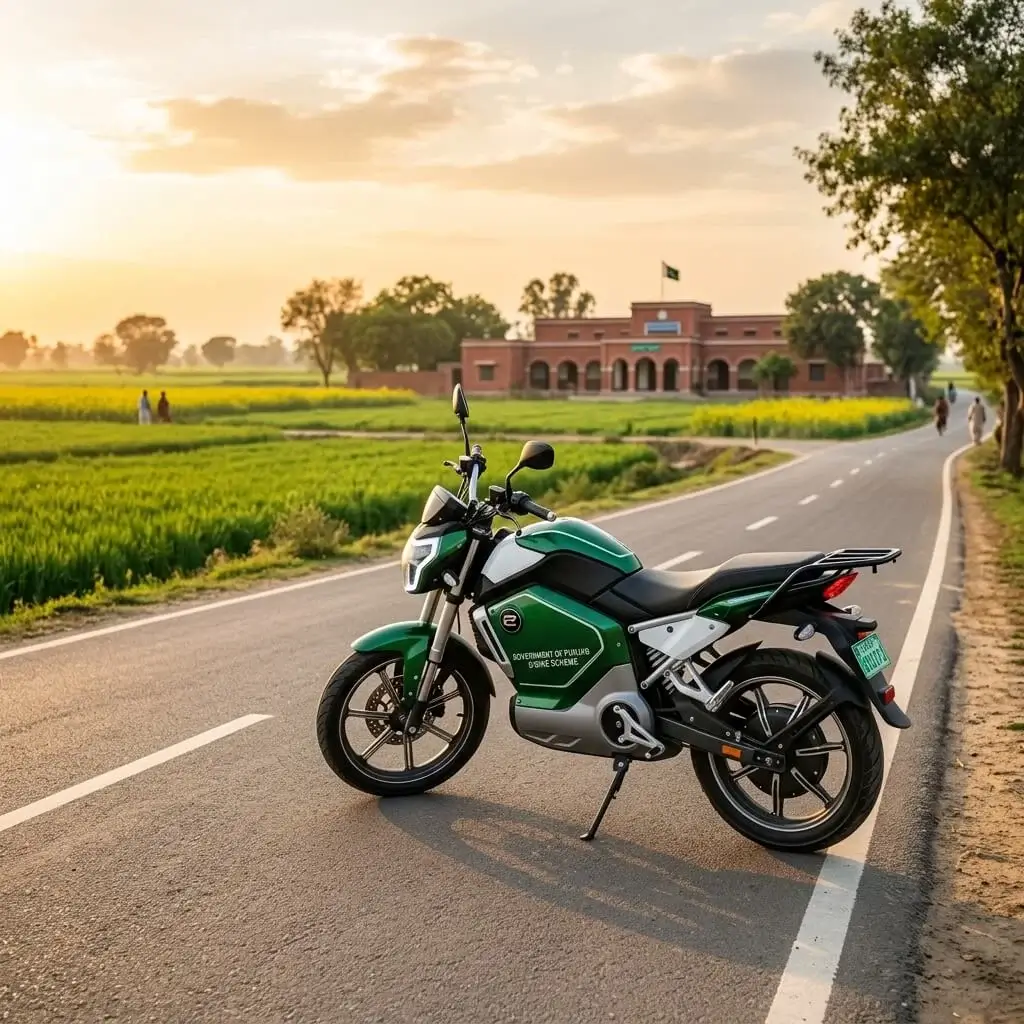
Chief Minister Maryam Nawaz Sharif's administration has introduced a comprehensive clean-air strategy that tackles pollution from multiple angles simultaneously. The strategy includes stricter emission standards for industrial units, a phased ban on crop burning with alternative residue management programs, expansion of the Bus Rapid Transit (BRT) system, and — most relevant here — the electrification of public sector transport through schemes like the CM Punjab E-Bike Teacher Scheme 2026 and the broader government employee e-vehicle initiative.
The e-bike scheme is positioned as a pilot demonstration project within this larger strategy. By targeting government school teachers — a visible, widely distributed, and relatable segment of the workforce — the government aims to normalize electric vehicles in everyday Punjab life. When a community sees its local teacher riding an e-bike to school every day, it creates a powerful endorsement effect that private marketing campaigns cannot replicate.
Measurable Emission Reductions from the E-Bike Scheme
Each petrol motorcycle replaced by an e-bike eliminates approximately 1 to 1.4 metric tons of CO₂ equivalent emissions per year, along with significant quantities of carbon monoxide, nitrogen oxides, and PM2.5 particulates. Across the scheme's target of 15,000 e-bikes (Phase 1 and Phase 2 combined), the annual emission reduction reaches approximately 15,000 to 21,000 metric tons of CO₂ — equivalent to planting 250,000 to 350,000 trees.
The local air quality impact is concentrated around schools and residential neighborhoods where teachers commute. These are precisely the areas where children, elderly residents, and other vulnerable populations are most exposed to vehicular pollution. By cleaning up the transport mode used by teachers, the scheme delivers a targeted improvement in air quality at the community level, where it matters most for public health.
Synergy with the CM Punjab Solar Scheme 2026
The e-bike scheme does not operate in isolation. It is designed to complement the CM Punjab Solar Scheme 2026 (Roshan Gharana), which installs free solar panels on eligible households to reduce dependence on grid electricity generated by fossil fuels. Together, these two programs form a coherent energy transition strategy: the solar scheme decarbonizes household energy consumption, while the e-bike scheme decarbonizes personal transportation.
For a teacher who benefits from both programs, the synergy is especially powerful. The solar panels generate clean electricity during daylight hours, and the teacher can charge their e-bike using this solar power when they return home from school in the afternoon. In this scenario, the entire commuting cycle — from energy generation to vehicle charging to road travel — becomes nearly carbon-free. This integrated model is exactly what urban planners and climate experts recommend for developing countries transitioning to sustainable energy systems.
Setting a Precedent for Future Transport Policy
The e-bike scheme is widely viewed as a stepping stone toward broader electric vehicle adoption in Punjab. If the program succeeds in demonstrating that e-bikes are reliable, affordable, and practical for daily use in Pakistan's climate and road conditions, it creates a strong case for extending similar programs to other public sector employees, police forces, postal workers, and eventually the general public. The infrastructure developed for this scheme — charging stations at schools, service centers in each district, financing models through the Bank of Punjab — can be scaled up to support a much larger e-vehicle ecosystem.
The Government of Punjab has already signaled its intent to announce additional e-vehicle schemes in the coming years. The success metrics being tracked for the teacher scheme — user satisfaction, reliability, cost savings, and emission reductions — will directly inform the design and scope of future programs. Every teacher who successfully adopts an e-bike is contributing not just to their own commute but to a larger data set that shapes Punjab's transport future.
Clean-Air Impact
Key Numbers: 15,000 e-bikes → ~15,000-21,000 tons CO₂ saved annually → Equivalent to 300,000 trees planted → Zero tailpipe emissions in school zones → Combined with Solar Scheme for near-zero carbon commuting.